Technology and AI: How Artificial Intelligence Is Transforming Our Life
Introduction
Nowadays, technology has become an essential aspect of our lives. With the help of smartphones, online stores, digital payment systems and educational programs, technology allows performing many actions easier and faster. One of the most innovative aspects of current technologies is Artificial Intelligence (AI). It changes people’s working and studying processes, communication and problem solving. With the development of technologies, it becomes increasingly necessary to understand Artificial Intelligence for students, specialists, and entrepreneurs.
What Is Artificial Intelligence (AI)?
Artificial Intelligence is a type of technology which allows machines and computers performing tasks, which require human intellect. Tasks which can be done by AI are recognition of language and images, analysis of information and generation of content.
In particular, voice assistants can react to questions, navigation systems offer a route, and AI chatbots can provide some information. Programs, like ChatGPT, can help with writing, brainstorming, learning and explanation of complicated subjects.
AI cannot think or understand something exactly as a person. Results of AI are dependent on data and systems which were used to create AI. Thus, it is necessary to analyze AI results.
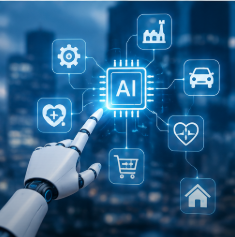
Impact of AI on Various Industries
AI brings many advantages to many different industries.
1. Education: AI technologies can facilitate explanation of difficult concepts, help to practice languages, and support individualized learning process. The technology can be used by teachers for the preparation of learning materials and educational events.
2. Healthcare: AI algorithms can analyze medical images, find patterns in the data related to health, and conduct researches in this sphere. However, there are some decisions that should be made only by qualified health care specialists.
3. Business: Companies use artificial intelligence to analyze customer behavior, automate processes, support customers, and make decisions based on this information.
4. Digital Marketing: AI allows marketers to come up with content ideas, analyze keywords, understand the preferences of their clients, and analyze campaigns. SEO specialists can use AI tools for research, but the original and informative content is required.
5. Transportation: Navigation technologies analyze the data and give recommendations about routes and time of traveling. In addition, AI helps researchers to create driver assistance systems and self-driving cars.
The listed examples show how AI technologies may increase efficiency in case of responsible usage.
Advantages of AI
There are many advantages that come with artificial intelligence for our daily lives and at work.
- Time-Saving: AI is able to handle some repetitive processes fast.
- Productive: It assists in organising information and idea generation.
- Learning: Students have an opportunity to learn difficult concepts using AI technologies.
- Data Analysis: AI technology can detect some patterns in the abundance of information.
- Innovative: It allows businesses and researchers to experiment with new solutions to current problems.
If used properly, AI can facilitate human decision-making and creativity instead of replacing them.
Problems and Challenges Related to AI
While there are many positive aspects of AI usage, it also poses some challenges. Firstly, some AI software may provide users with incorrect or false information. Secondly, AI-generated content may be biased depending on the data that is used for training the system.
Privacy is one more important problem. Users should not enter any passwords, money-related information, etc., to AI-based software.
Finally, automation might change the job market in the future. There will probably be less need for people to perform repetitive tasks, but new opportunities are likely to appear in IT, data analysis, cybersecurity, and artificial intelligence.
It is important to mention that there are ways to cope with these issues – digital literacy and critical thinking.
How Students Can Begin to Learn AI
Students do not have to be expert coders in order to begin studying about artificial intelligence. They can get started by learning the basic ideas behind AI and working on simple tools.
Here are some helpful actions:
- Learn about basic computers and digital technology.
- Discover AI tools used for writing, research, and efficiency.
- Ask clear and specific questions.
- Study basic coding skills if planning an AI career.
- Verify AI information with credible sources.
- Work on projects that help solve problems.
Students should regard AI as an educational tool, not as an alternative to their own reasoning and creativity.
Conclusion
Technology and Artificial Intelligence are changing the world today. AI technology is assisting in learning, productivity of organizations, and solving complicated issues by professionals. But at the same time, it poses questions related to precision, privacy, jobs, and ethical application.
The future belongs to those people who can adapt to technological developments and at the same time continue their learning process. It will be beneficial for everyone to learn about AI and apply it properly.